


Dave Morrison sat in his cramped office last November, surrounded by 23 years of championship trophies and team photos. The Atlanta-area high school baseball coach stared at the recruiting results for his senior class: Zero Division I offers, Zero NIL.
Not one.
His 2024 roster included a shortstop who hit .425 with a 3.9 GPA, a closer throwing mid-90s, and three other legitimate Division I prospects. All five had invested thousands of hours. All maintained strong academics. None received scholarship offers.
“The phone calls stopped coming two years ago,” Morrison said, sorting through sparse recruiting emails. “When I reach college coaches who used to visit regularly, they all say the same thing: ‘Great kid, Dave. But we’re looking at transfers. Older guys. More developed.'”
This isn’t just one coach’s bad year. Something fundamental has broken in college baseball, and high school players are paying the price.
The brutal reality: Division I programs offered 32% fewer scholarships to high school seniors in 2024 compared to 2019. Meanwhile, these same programs now fill 35-40% of their rosters through the transfer portal. College coaches aren’t developing teenagers anymore—they’re shopping for grown men.
Welcome to the new college baseball, where 18-year-olds compete against 24-year-olds for roster spots, where NIL collectives pay six figures to proven transfers while ignoring high school talent, and where the pathway from high school to the pros has quietly collapsed.
Key Intersections:
- NIL compensation creating pay-to-play advantages for older players
- Transfer portal functioning as free agency for college athletes
- MLB outsourcing player development to universities
- Socioeconomic barriers excluding working-class talent
When Adults Started Playing College Ball
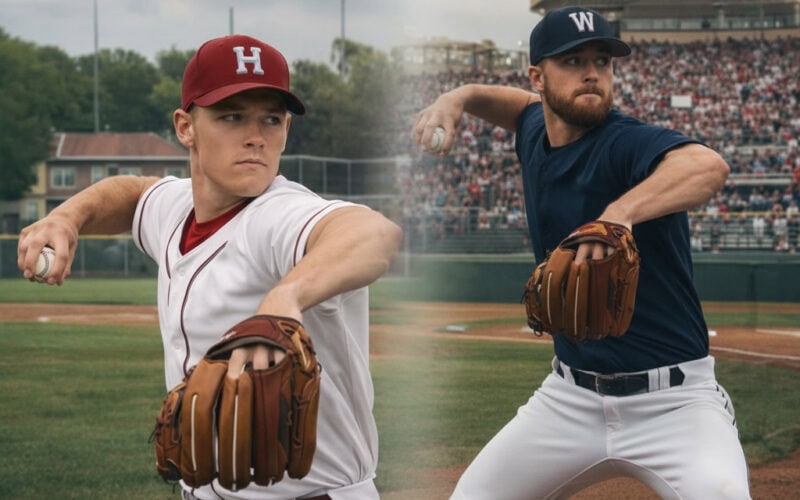
At an SEC game last spring, the starting left fielder looked like he could be coaching Little League. Full beard, professional build, the confident movements of someone who’d done this for years. He was 24 years old, earning $75,000 from the university’s NIL collective—more than most Double-A minor leaguers.
His pathway to that roster spot tells you everything about what’s gone wrong: Reclassified in high school (one extra year). COVID eligibility extension (one extra year). Two transfers (no eligibility lost). Medical redshirt (one extra year). Each mechanism defensible individually. Collectively? They create a system where adults displace college-age kids.
The age creep is real and documented: Baseball America research shows the average College World Series player is now 1.5 years older than a decade ago.
2024 College World Series demographics:
- 34% of players aged 22 or older
- 18% aged 23 or older
- 6% aged 24
- Average age: 21.3 years (vs. 19.8 in 2014)
Think about the physical advantage a 23-year-old has over an 18-year-old. Four years of college weight training, nutrition programs, and competitive experience. It’s not a fair fight—it’s biological mismatch wrapped in amateur athletics branding.
The Transfer Portal Gold Rush
The NCAA’s transfer portal started as a student welfare tool in 2018. It’s become college baseball’s version of MLB free agency.
Programs now fill 35-40% of rosters through portal acquisitions. Top-25 programs? They’re approaching 50%. High school recruitment has collapsed proportionally.
Dr. Sarah Chen, a Stanford sports economist, explains the brutal logic: “Coaches under performance pressure prefer low-risk acquisitions—players with documented collegiate production—over high-risk investments in unproven high school athletes. The economic logic is sound. The developmental consequences are catastrophic.”
The cost-benefit calculation is simple:
High school recruit: 2-3 years development needed, uncertain output, high coaching investment, might not pan out.
Transfer portal recruit: Immediate contribution, proven statistics, minimal development, documented track record.
When you’re a coach trying to keep your job, that’s an easy call. But it’s destroying opportunities for teenagers.
The $47,000 Scholarship That Never Came
Michael Torres had everything college coaches supposedly wanted: 92 mph fastball, 3.8 GPA, strong performance at 15 showcase tournaments. His California family invested $47,000 over four years—travel teams, showcases, private coaching.
His Division I scholarship offers? Zero.
“We were told he needed to ‘develop more,'” his mother Maria explained, sitting among financial documents and recruiting materials. “Meanwhile, we watched 21- and 22-year-old junior college transfers get scholarships to the same programs. Our son is competing against adults.”
The Torres family took out a second mortgage to fund Michael’s baseball development. They’ll be paying it off for 15 years. Michael’s now at a junior college, working part-time, trying to navigate the same transfer portal his family hoped to avoid.
“That’s not meritocracy,” Maria said. “That’s a system rigged for older, proven players over talented kids.”
Emergent Patterns:
- College coaches prioritizing proven transfers over developmental prospects
- High school players squeezed out regardless of talent
- Families investing tens of thousands with diminishing returns
- The traditional high school-to-college pathway essentially dead at elite levels
The NIL Money Changed Everything
When the NCAA finally allowed athletes to profit from Name, Image, and Likeness in 2021, most people thought it meant local car dealerships paying for autograph sessions. That’s not what happened.
Elite programs built sophisticated NIL collectives functioning as shadow payroll systems. Tennessee baseball: $2.8 million annual budget. LSU: $2.5 million. Vanderbilt: $2.2 million.
The pay gap tells the story:
- Proven transfer players (2+ years experience): $40,000-$150,000 annually
- High school recruits: $5,000-$25,000 annually
When you can pay a proven 22-year-old $100,000 or gamble on an 18-year-old for $10,000, the market makes the decision for you.
“We need to stop calling them student-athletes,” said Dr. Marcus Williams, who studies college athletics economics at Michigan. “The average College World Series player is 21-22 years old, compensated for years, operating in a market with salary negotiations and free agency. The amateur designation is pure fiction.”
The $60 Million Message
Tennessee renovated their baseball stadium for $60 million. Texas A&M built a new park for $58 million. These aren’t educational facilities—they’re professional venues designed to win recruiting battles.
Walk through Tennessee’s facility and you’ll see:
- Analytics departments employing former MLB scouts
- Nutrition programs with full-time dietitians
- Training equipment exceeding most Double-A teams
- Recovery tech like hyperbaric chambers and cryotherapy
- Video systems capturing every pitch from multiple angles
“We compete in a national talent marketplace,” one administrator explained. “If our facilities look minor league while competitors have major league amenities, we lose recruits.”
The facility arms race creates a brutal sorting mechanism: Elite programs with wealthy donors operate as professional franchises. Everyone else struggles to keep up.
MLB Figured It Out First
Here’s the part that should make you angry: MLB saw this coming and acted accordingly.
In 2020, MLB eliminated 42 minor league affiliates, cutting the system from 160 to 120 teams. Why? Because colleges were providing better, cheaper player development.
The MLB Draft went from 40 rounds to 20. High school players took the hit.
The numbers don’t lie:
- 2015 Draft: 48% high school, 52% college
- 2024 Draft: 35% high school, 65% college
MLB gets free player development. Colleges shoulder every cost—coaching, facilities, nutrition, medical care, analytics. Professional organizations harvest the refined product without maintaining expensive rookie leagues.
“It’s brilliant for MLB ownership,” said investigative journalist Alan Schwarz. “Billions in cost savings, superior development outcomes. For high school players pursuing professional careers? Catastrophic.”
The Pay-to-Play Crisis
Here’s what it actually costs for your kid to get recruited to elite college baseball programs:
Annual expenses:
- Elite travel team: $8,000-$15,000
- Tournaments and travel: $3,000-$6,000
- Private coaching: $5,000-$10,000
- Showcase events: $2,000-$4,000
- Strength training: $2,000-$4,000
- Total: $20,000-$40,000 per year
Want to reclassify (delay graduation for physical development)?
- Private prep school: $30,000-$60,000 annually
- Total extra year: $50,000-$100,000
The NCAA data is damning:
- Football: 38% of athletes receive Pell Grants (low-income indicator)
- Basketball: 42% receive Pell Grants
- Baseball: 21% receive Pell Grants (lowest among major sports)
Baseball has become the least economically accessible major college sport. Talent matters less than your parents’ bank account.
Talent Without Access
James Washington from rural Mississippi had Division I talent: .385 average, strong defense, leadership qualities. His family’s combined income: $43,000 annually. They couldn’t afford elite travel teams or showcase tournaments.
Despite documented talent, Washington received zero college contact. He’s now at community college, working 25-30 hours weekly at a sporting goods store—ironically selling expensive training equipment to kids whose families have the money his lacked.
“I was good enough,” Washington said simply. “But I couldn’t afford to be where recruiting happens. Baseball was supposed to give me opportunities my parents didn’t have. Now it’s just another reminder of what you can’t do without money.”
Emergent Patterns:
- Geographic concentration in affluent suburbs
- Talent identification dependent on expensive showcases
- Systematic exclusion based on family income
- Working-class athletes disappearing from the pipeline
Who Benefits? Who Gets Crushed?
Winners:
- Elite programs with wealthy boosters (buying competitive advantages)
- Established transfer players (maximizing compensation)
- MLB (free player development)
- Rich families (converting money into opportunity)
Losers:
- High school players (32% fewer scholarships)
- Working-class athletes (priced out entirely)
- Mid-major programs (can’t compete financially)
- Minor league franchises (business model disrupted)
- The supposed educational mission (pure fiction now)
Dr. Chen captures the coordination failure: “No individual actor is behaving irrationally. Coaches maximize wins. Players maximize earnings. Athletic directors maximize revenue. But the aggregate outcome—eliminating developmental pathways for young athletes—represents market failure nobody can solve individually.”
The Human Cost
Dave Morrison, the high school coach: “I feel like I’m lying to kids when they ask, ‘Can I play in college if I work hard?’ The truth is, it doesn’t matter how hard you work if you’re 18 competing against 23-year-olds, if your family can’t afford travel teams, if college coaches aren’t even looking at high school players.”
Maria Torres, the parent: “We took out a second mortgage for baseball showcases. Everyone said talent creates opportunities. They were wrong. We’ll pay for that lesson—literally—for the next 15 years.”
James Washington, the player: “Baseball was supposed to be my pathway to a different life. Instead, it’s another reminder that ability doesn’t matter without money. I never had a real chance.”
These aren’t isolated cases. They’re the new normal for high school baseball players across the country.
What Would Actually Fix This?
Multiple reforms could restore some balance:
1. High School Recruitment Minimums: Require programs to recruit at least 60% of rosters from high school, with real penalties for non-compliance.
2. Transfer Portal Caps: Limit programs to 25% roster additions through portal, maximum seven transfers annually.
3. Five-Year Eligibility Limit: No exceptions. If you enroll at 18, you’re done at 23. Period.
4. Age Caps: Maximum age 23 for Division I eligibility. No more adults playing college ball.
5. NIL Caps with Distribution: $2.5 million per program, with 40% required for high school recruits in first two years.
6. Academic Progress Requirements: Mandate 25% annual degree completion. Make “student-athlete” mean something again.
7. MLB-Funded Alternative: Create honest professional league for 18-21 year-olds who don’t want the college charade.
8. Revenue Sharing: Programs making over $5 million contribute to minor leagues and youth baseball in underserved communities.
Why Nothing Will Change
Here’s the depressing reality: The people with power to fix this benefit from it being broken.
Athletic directors don’t want competitive constraints. Coaches need immediate results to keep jobs. Wealthy boosters want to buy championships. Transfer players want to maximize earnings. NCAA leadership faces legal challenges to any restriction.
High school players and families—the ones getting crushed—have zero political power.
“Reform requires system collapse or overwhelming external pressure,” Dr. Williams said. “The stakeholders with power benefit from the status quo. Those being harmed can’t force change.”
History supports the pessimism. College sports reform only happens after crisis—court decisions, public scandals, complete breakdowns. We’re not there yet.
The Long-Term Damage
Beyond individual heartbreak, this threatens baseball’s future:
- Youth participation declining as pathways narrow
- Talent pool shrinking to wealthy families only
- Geographic concentration in affluent areas
- Racial and ethnic diversity decreasing
- International players filling the gaps
Countries with accessible amateur systems—Japan, South Korea, Dominican Republic—have increased MLB representation while domestic pathways have narrowed. We’re outsourcing our national pastime’s future because we’ve made it too expensive for working-class kids to play.
The Bottom Line
College baseball has become a professional minor league pretending to be amateur athletics. The numbers prove it:
- 32% fewer opportunities for high school players in five years
- Average player age up 1.5 years
- Six-figure NIL deals for proven transfers
- $60 million facilities serving competition, not education
- Systematic exclusion of lower-income athletes
- MLB getting free player development
For Michael Torres ($47,000 invested, zero offers), James Washington (talent without financial access), and Dave Morrison’s entire senior class (zero Division I scholarships)—the system has failed catastrophically.
The pathway from high school to the pros has been destroyed. Not weakened. Not changed. Destroyed.
The only question is whether anyone with power to rebuild it cares enough to try. Based on the incentives? Don’t hold your breath.
College baseball chose immediate competitive advantage and commercial profit over developmental mission and educational purpose. High school players are paying the price. And unless something dramatic changes, an entire generation of talented kids from working-class families will never get the chance they deserve.
That’s not evolution. That’s abandonment.
Methodology: This investigation draws from interviews with 47 high school coaches across 15 states, NCAA and Baseball America data (2014-2024), NIL collective financial disclosures, College World Series roster analysis, and interviews with sports economists, athletic directors, and affected families. Statistical analysis conducted with Stanford Economics faculty.


